The time has come for class to end, and for me to evaluate my work here on my blog. It's been fun talking about Hamlet and how Hamlet has been an inspiration and a sort of cultural reference point, and also my less focused topic of Shakespeare and popular culture.
A. Posts: I feel that I have written a respectable number of posts that relate to my topic, and that they tie in pretty well to my Thesis: "Shakespeare’s play Hamlet has been an inspiration and a source of cultural reference points for the people that have gone before us and it still is for us, the people, now." Most of my posts do have some sort of related image, though most of my posts do not have any other sort of media. I don't know if I could say that I spent a lot of time analyzing primary sources. I do a little bit in my post Ophelia, Her Death as Mad and as Picturesque as Our Imagination Paints It which is probably my best and most varied post. I do spend some time analyzing Hamlet movies and references in a popular TV show, though the actual analysis is not spectacular. I do think that they are formatted well, with useful titles, pagebreaks, and tags. I probably should have rewritten my hub post to incorporate Some Supporting Quotes from the Epilogue of Approaches to Teaching Shakespeare's Hamlet and a further discussion on the article
"Whither Shakespop?" ... though my hub post took me ages and I really did want to rewrite it.
B. Research: I possibly could have done a better job researching. I do think that I eventually reached a fair Thesis and was able to draw support for that Thesis with my own work and the work of my peers. My process is fairly well documented and you can see if you go back through my blog how my thoughts jump from one place to another but dwell most on Hamlet, Popular Culture, and Shakespeare's Legacy, and I did show how I was struggling to come to a coherent thesis in my posts In Search of a Focus and Thesis. I have a sources page where I think all of my resources are gathered, in a style that is not MLA, and most of them are properly linked to something related (if it's a book, it may link to the Amazon page for that book, which is what seemed like the best idea at the time). The last few sources are not linked because of technical difficulties in editing the page.
C. Personal and Social: I feel that my personality and connection to my posts is pretty clear through my side-content, and my voice, and probably my design too. There are posts, which I talked about and linked to in the paragraph above, that were explicitly me talking about my process. My hub post shows a pretty clear connection to my peers.
D. Design: I think my design is good. I like the background, and the side-content, and all of my design. I don't think any of it detracts, and I think some of it, like my tags, should be very useful.
Showing posts with label Hamlet. Show all posts
Showing posts with label Hamlet. Show all posts
Thursday, April 14, 2011

Friday, April 8, 2011
Some Supporting Quotes from the Epilogue of Approaches to Teaching Shakespeare's Hamlet
I found some phrases I really like in the epilogue to the book Approaches to Teaching Shakespeare's Hamlet which is "Cheating Death: The Immortal and Ever-Expanding Universe of Hamlet" by Maria M. Scott.
The first of these great quotes is:
Another great quote follows close after that one "If the dilemma facing Shakespeare scholars today is that there's just not that much more we can say about him, surely that dilemma is doubly pronounced in relation to Hamlet." This dilemma is one that I sympathize with, since I too was trying to say something about Hamlet, and there is so much already said that anything else just seems superfluous.
There's one more quote from this epilogue that I like and that echoes and reinforces my own ideas about Hamlet and society is "we have the opportunity to show that Hamlet remains relevant as a cultural icon and continues to evolve." Of course, this book is written for teachers as an aid for them, but I think it applies just to the simple studying of the play. "We have the opportunity to [see] that Hamlet remains relevant as a cultural icon and continues to evolve" and that it continues to evolve both in how we view the original text and in how we adapt it and make use of it for new creative performances and works.
So, I like the epilogue to this book, it agrees with me.
The first of these great quotes is:
This passage is exactly in line with my thesis that Shakespeare has seriously influenced our culture, both serving as an inspiration for new ideas and as a commonly known set of ideas that can be easily referenced.Perhaps more than any Shakespearean text, Hamlet is embedded in our collective cultural consciousness long before we actually encounter the gloomy Dane in the pages of his play. The question "To be or not to be?" is as over-determined as the direction to "have a nice day." However, the original text has been reinterpreted and retransmitted so many times that what we receive sometimes only vaguely resembles the original message.

Another great quote follows close after that one "If the dilemma facing Shakespeare scholars today is that there's just not that much more we can say about him, surely that dilemma is doubly pronounced in relation to Hamlet." This dilemma is one that I sympathize with, since I too was trying to say something about Hamlet, and there is so much already said that anything else just seems superfluous.
There's one more quote from this epilogue that I like and that echoes and reinforces my own ideas about Hamlet and society is "we have the opportunity to show that Hamlet remains relevant as a cultural icon and continues to evolve." Of course, this book is written for teachers as an aid for them, but I think it applies just to the simple studying of the play. "We have the opportunity to [see] that Hamlet remains relevant as a cultural icon and continues to evolve" and that it continues to evolve both in how we view the original text and in how we adapt it and make use of it for new creative performances and works.
So, I like the epilogue to this book, it agrees with me.
Tuesday, April 5, 2011
Hamlet Shows Shakspeare's Long-Lasting Cultural Effect

What is Popular Culture? The definition in “The Introduction” by Stuart Gillespie and Neil Rhodes to Shakespeare and Elizabethan Popular Culture seems like a good definition to me “cultural products created of the people… for the people.” But who are “the people?” In this introduction they say that “citizens and yeomen were frequently were frequently classed together as ‘the middling sort of people’, divided between town and country and it is these groups rather than those who ‘have no voice nor authority in our commonwealth as Smith puts it, who would usually have been referred to as ‘the people’.” To me, this is an insufficient definition of “the people.” Everyone, from the Queen down to “those who ‘have no voice nor authority’” are people and are therefore part of “the people.” Sometimes it is useful to look at the different aspects of a culture, the types of literature that make it into textbooks, films that win awards and praise while being perhaps a little too aware of their own artsy-ness and other praise-able qualities, art that is found in museums, to the generally enjoyed books, movies, and TV… and other aspects of a culture that are less snobby and may or may not have plenty of their own merits. Shakespeare wrote for and was appreciated by the snobby elite and the groundlings and the in-betweens of his own day, and he has returned (if he ever left) from the realms of the snobby elite to being accessible and enjoyable to all of the people from the snobby elites to the couch potatoes. Shakespeare’s play Hamlet has been an inspiration and a source of cultural reference points for the people that have gone before us and it still is for us, the people, now.
Monday, April 4, 2011
Thesis
My current thesis and conclusion are:
Shakespeare is still popular in popular culture, the kind of culture that is of the people and for the people, but he belongs not just to the popular or just to the high-brow but he can be found comfortably fitting in throughout our culture as a cultural reference point and an inspiration for new art and literature and this can be best seen in his best-known play, Hamlet.
Is this a good or a bad thing? "Does familiarity breed contempt?" (which is a question asked and discussed in “Introduction: whither Shakespop? Taking stock of Shakespeare in popular culture” which I intend to talk more about soon) Perhaps, but most of the people who despise it now, would still, I think, not appreciate it without all of the cultural strings attached, without the “decontextualized appropriations solely for commercial gain”(another quote from Wither Shakespop) and without all the parodies. I don’t necessarily think that everything that’s attached itself to Shakespeare is good, or anything of the sort, but I do think that new interpretations and spins inspired from and working off of Shakespeare’s work themselves benefit from using Shakespeare as a source and that they can also benefit a study of Shakespeare’s works by breathing new life into the old texts.
Sunday, April 3, 2011
Reference to Hamlet in General Conference

So, we have an answer to that old question, and the answer is "Be".
Thursday, March 31, 2011
A Shattered Mirror is Multi-faceted
 One of the most interesting, though perplexing, images in David Tennant (and Patrick Stewart and Penny Downie)'s Hamlet was this broken mirror. I recognized that it was probably an important symbol but I didn't bother trying to figure it out until today. I've come up with several theories now though. My favourite one connects to my general interest in Shakespeare, especially Hamlet, in the eyes of Popular Culture; Hamlet is one of the best remembered of Shakespeare's plays, but people remember it in very different ways and not always clearly.
Tuesday, March 29, 2011
In Search of a Focus
I'm afraid that I don't really know what the focus of my research is. I've tried to concentrate largely on Shakespeare and his relation to popular culture, or to culture in general, and I have found Shakespeare in many places.
So far I've discussed how: in both the movie and the book versions of Jane Austen's Sense and Sensibility MaryAnne and Willoughby quote Shakespeare's sonnets, I remember quite a few references or allusions to Romeo and Juliet, I found that the British TV show Doctor Who has an entire episode relating to The Shakespeare Code and a TV charity called Comic Relief had a comedy skit with both Doctor Who jokes and Shakespeare jokes, a simple google search of the phrase "all the world's a stage" turned up tons of hits in all sorts of places, in Dostoevsky's The Brothers Karamazov I found more than one reference though I've only yet written about the first instance, and even the names of Uranus's moons are Shakespeare-themed. I've looked into how Shakespeare was influenced by the popular culture of his own time, and the example of the similarities between Hamlet and Tom a Lincoln.
I've found myself slowly drawn towards Hamlet, as I've found connections between that play and life. In the same class discussion which led to my post on Justice and Mercy about The Merchant of Venice, we talked about Hamlet and the Reformation. I've watched two different film adaptations which each connected to other ideas that interest me (such as fanfiction to Branagh's in a vague way which really had more to do with the play than anything particular and Doctor Who to Tennant's though Jessica's post does a better job of showing the connections). I've done two posts on Ophelia on impulses, the second one spinning off an insignificant painting in the first. But I have become rather interested in the characters of Hamlet and Ophelia, what influenced their creation and how they've influenced people (mostly writers of one sort or another) and become an allusion to illustrate ideas.
So far I've discussed how: in both the movie and the book versions of Jane Austen's Sense and Sensibility MaryAnne and Willoughby quote Shakespeare's sonnets, I remember quite a few references or allusions to Romeo and Juliet, I found that the British TV show Doctor Who has an entire episode relating to The Shakespeare Code and a TV charity called Comic Relief had a comedy skit with both Doctor Who jokes and Shakespeare jokes, a simple google search of the phrase "all the world's a stage" turned up tons of hits in all sorts of places, in Dostoevsky's The Brothers Karamazov I found more than one reference though I've only yet written about the first instance, and even the names of Uranus's moons are Shakespeare-themed. I've looked into how Shakespeare was influenced by the popular culture of his own time, and the example of the similarities between Hamlet and Tom a Lincoln.
I've found myself slowly drawn towards Hamlet, as I've found connections between that play and life. In the same class discussion which led to my post on Justice and Mercy about The Merchant of Venice, we talked about Hamlet and the Reformation. I've watched two different film adaptations which each connected to other ideas that interest me (such as fanfiction to Branagh's in a vague way which really had more to do with the play than anything particular and Doctor Who to Tennant's though Jessica's post does a better job of showing the connections). I've done two posts on Ophelia on impulses, the second one spinning off an insignificant painting in the first. But I have become rather interested in the characters of Hamlet and Ophelia, what influenced their creation and how they've influenced people (mostly writers of one sort or another) and become an allusion to illustrate ideas.
Tuesday, March 22, 2011
David Tennant's Hamlet, and what I thought
 I've just finished watching the David Tennant version of Hamlet. As you may know, David Tennant played The Doctor, in the Doctor Who TV show, which is why I was interested to see this version. There were a couple of things that struck me as I watched it.
1. It's exceedingly odd to see David Tennant playing somebody who is not The Doctor. When he first shows up on screen his hair is all... brushed back and too neat and tidy looking, though he soon musses it up and it looks natural again. Also, sometimes his facial expressions would throw me off when he'd make some expression that I associate with The Doctor.
Thursday, March 17, 2011
Was Ophelia Ever There At All

Ophelia allowed her father to control her, then she went mad, and then she died off-stage. Where was Ophelia, and Ophelia's mind and will, in any of this? It's almost like all there was to her was innocence, maidenhood, death by drowning, and her not being there and in control in any of the crucial moments of her life and death throughout everything we see of her in the play.
Wednesday, March 16, 2011
Shakespeare in the Sky

But they are there, and the fact that they were named mostly after Shakespearean characters shows that while most heavenly bodies are named after the old classical traditions, Shakespeare is part of an important tradition too.
This picture is one I got from the Astronomy Picture of the Day site, which has lots of lovely astronomy pictures and information.
Tuesday, March 15, 2011
Ophelia, Her Death as Mad and as Picturesque as Our Imagination Paints It

Today I was reading Brothers Karamazov for one of my other classes (Honors 202, a Civ 2 class, called The Bible in Western Literary Tradition) and I was surprised to find a Shakespeare reference. At the bottom of the first page and the top of the second in Part One, Book One, there is an interesting passage
And so she died, entirely to satisfy her own whim, and to be like Shakespeare's Ophelia. If this precipice, a chosen and favorite spot of hers, had been less picturesque, if there had been a prosaic flat bank in its place, most likely the suicide would have never taken place. This is a fact, and there probably have been a few similar cases in the last two or three generations.
Tuesday, March 8, 2011
Hamlet and Tom a Lincoln
 I've recently been thinking about Shakespeare and Popular culture, both the popular culture of Shakespeare's day (the culture of the people, manifested in various ways) and though unrelated to this post the popular culture of today. In one of the chapters of Shakespeare and Elizabethan Popular Culture David Margolies suggests that Hamlet may be a bit of a remake of another well-liked revenge play of the day called Hamlet and that a book, or a work of fiction, called Tom a Lincoln by Richard Johnson may have added "new significance."(pg 125) I don't really understand, though, how a book described as "being shallow and disconnected" (Pg. 125) could add that significance. If we knew more about the original Hamlet then it would be a lot easier to say.
There are similarities between the two stories.
Sunday, January 30, 2011
Thoughts on Watching Hamlet
I was somewhat surprised by several things in the Kenneth Branagh version of Hamlet, which is the first and only production of Hamlet that I've seen (The Reduced Shakespeare Company doesn't count.)
Nobody looked quite how I pictured them.
When Hamlet was lamenting how much greater his father was to his uncle, and how much more attractive... I looked at the two, and I found Hamlet's dad even less attractive than his uncle. I guess Hamlet and his mother have a right to be biased, and there was a different society then.
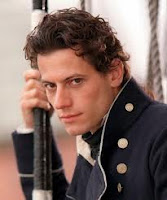 For another thing, I always imagined Horatio looking like Horatio Hornblower (named after Hamlet's Horatio) from the English TV series based on the Horatio Hornblower books, though in a role more suited to Horatio's friend Archie Kennedy and with some personality traits of them both. (This reminds me of some fanfiction stories where Archie tries to get Horatio Hornblower to read and/or appreciate Archie's favourite play, Hamlet, or where he's quoting "there are more things in heaven and earth, Horatio, / Than are dreamt of in your philosophy" (Act I scene V). In the TV series Archie is a fan of the theatre, and can quote famous lines, but the idea the Hamlet-related stuff is just fanfiction.) The actor did a good job, and I liked him well enough once he wasn't wide-eyed in terror over the ghost.
I didn't picture Ophelia as Kate Winslet. I didn't imagine her as a girl whose fiery nature was being suppressed by her brother and father. I didn't believe that she and Hamlet had done anything... But, it was an interesting take on her character. She says all the same lines, the only thing clearly added was the flashback scenes of them being intimate while people were yelling at her, but she does manage to make the character I pictured as rather meek and docile fiery. I also was surprised at just how frighteningly crazy she seemed when Ophelia went mad. I guess I always had a more light-hearted imagining of crazy Ophelia than the true tragedy that Kate Winslet was able to convey.
The move also put in some other unnecessary sexuality with a whore in Polonius's room, and Hamlet thinking (and you see) King Claudius and the Queen drunkenly falling into bed. This surprised and bothered me.
The players didn't bore me nearly as much as they did when I've read them. I guess Charlton Heston helped.
Even though people spoke really fast (especially Hamlet) there were times during the long speeches that I just wanted whoever it was (Claudius, Polonius, Hamlet, even Laertes once or twice) to just shut up already. I understood that they were being brilliant, but my modern sensibilities were offended by such long monologues. I did enjoy a good number of Hamlet's speeches, even the longer ones, it was just some of them that I got tired of.
I find it interesting that the three young people who die were all portrayed, in the beginning, as very contained people, whether it was self-containment or from pressures from family and society, they were contained. By the end two of them are blatantly acting or are mad, and Laertes doesn't seem all there either. Ophelia seemed truly crazy, but she seemed once more free and more confined and trapped than she had at the beginning. She was free to say what she wanted, and she ran around and did things that people thought were strange, but she still ended up getting physically locked up places and trapped in her own mind. Her death was kind of like a release from all the constraints of various sorts she'd dealt with. Hamlet acts crazy at times, but not very, mostly he seems like he's just done with trying to contain his anger and frustration with people, and as he is not able to take his revenge safely and completely, he takes his anger out on Ophelia, his friends who are spying on him, his mother, and Polonius (at the end it wasn't entirely intentional that way, it still ended up that way). Laertes is just a little crazed with grief and releases it in socially acceptable forms of seeking revenge and mourning melodramatically at Ophelia's grave.
Just a few thoughts.
Nobody looked quite how I pictured them.
When Hamlet was lamenting how much greater his father was to his uncle, and how much more attractive... I looked at the two, and I found Hamlet's dad even less attractive than his uncle. I guess Hamlet and his mother have a right to be biased, and there was a different society then.
 For another thing, I always imagined Horatio looking like Horatio Hornblower (named after Hamlet's Horatio) from the English TV series based on the Horatio Hornblower books, though in a role more suited to Horatio's friend Archie Kennedy and with some personality traits of them both. (This reminds me of some fanfiction stories where Archie tries to get Horatio Hornblower to read and/or appreciate Archie's favourite play, Hamlet, or where he's quoting "there are more things in heaven and earth, Horatio, / Than are dreamt of in your philosophy" (Act I scene V). In the TV series Archie is a fan of the theatre, and can quote famous lines, but the idea the Hamlet-related stuff is just fanfiction.) The actor did a good job, and I liked him well enough once he wasn't wide-eyed in terror over the ghost.
I didn't picture Ophelia as Kate Winslet. I didn't imagine her as a girl whose fiery nature was being suppressed by her brother and father. I didn't believe that she and Hamlet had done anything... But, it was an interesting take on her character. She says all the same lines, the only thing clearly added was the flashback scenes of them being intimate while people were yelling at her, but she does manage to make the character I pictured as rather meek and docile fiery. I also was surprised at just how frighteningly crazy she seemed when Ophelia went mad. I guess I always had a more light-hearted imagining of crazy Ophelia than the true tragedy that Kate Winslet was able to convey.
The move also put in some other unnecessary sexuality with a whore in Polonius's room, and Hamlet thinking (and you see) King Claudius and the Queen drunkenly falling into bed. This surprised and bothered me.
The players didn't bore me nearly as much as they did when I've read them. I guess Charlton Heston helped.
Even though people spoke really fast (especially Hamlet) there were times during the long speeches that I just wanted whoever it was (Claudius, Polonius, Hamlet, even Laertes once or twice) to just shut up already. I understood that they were being brilliant, but my modern sensibilities were offended by such long monologues. I did enjoy a good number of Hamlet's speeches, even the longer ones, it was just some of them that I got tired of.
I find it interesting that the three young people who die were all portrayed, in the beginning, as very contained people, whether it was self-containment or from pressures from family and society, they were contained. By the end two of them are blatantly acting or are mad, and Laertes doesn't seem all there either. Ophelia seemed truly crazy, but she seemed once more free and more confined and trapped than she had at the beginning. She was free to say what she wanted, and she ran around and did things that people thought were strange, but she still ended up getting physically locked up places and trapped in her own mind. Her death was kind of like a release from all the constraints of various sorts she'd dealt with. Hamlet acts crazy at times, but not very, mostly he seems like he's just done with trying to contain his anger and frustration with people, and as he is not able to take his revenge safely and completely, he takes his anger out on Ophelia, his friends who are spying on him, his mother, and Polonius (at the end it wasn't entirely intentional that way, it still ended up that way). Laertes is just a little crazed with grief and releases it in socially acceptable forms of seeking revenge and mourning melodramatically at Ophelia's grave.
Just a few thoughts.
Thursday, January 20, 2011
Feeling Hamlet-like? Just a little.

Most days in the winter I don't feel like getting up, or going to class, and I certainly don't feel like doing my homework. I've been thinking about doing my homework, knowing that I should, but since I lacked the desire, determination, and clear idea of how to go about it, I've been putting it off.
The other day, I was venting my frustration with myself by talking to my roommates when suddenly the mood struck me and with the announcement that I felt melodramatic I dropped to one knee, put one hand on my forehead, and held the other in front of me in a fist as I confessed in a gasping, despairing, melodramatic way that I had done nothing but read fanfiction for four days and I had not done my homework.
One of my roommates laughed and asked in a skeptical voice, "And you don't want to read Hamlet?"
Subscribe to:
Posts (Atom)